Showing posts with label bethany. Show all posts

Wednesday, June 4, 2008

More Exam Review

Here's the example study sheet Mr. Max gave us a few days ago. To gain more assignment marks, we have the option to make 8 of these (one for each unit) or study sheets of some sort for Friday. Basically the idea is to go through each learning outcome (from the Manitoba curriculum sheet) and put examples or references to examples. If you know you are well-versed in that particular outcome, you can put a check mark or some such symbol.

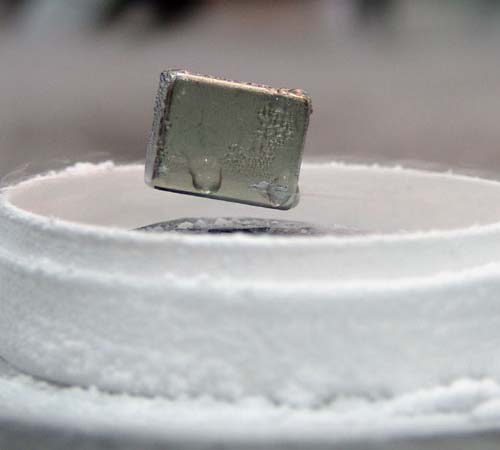
Class today was more preparation for the exam. We also spent a fairly significant amount of time discussing how to find a superconductor for Cindy. Because she misplaced hers. Here's a picture of one in action.

http://www.chemistryland.com/CHM107/AirWeBreathe/Comp/superconductor2.jpg

It was a fairly productive class I suppose, especially for Anna who made the most of the whole 10 minutes she decided to bless us with her presence.

I guess that's it for now. Our class is getting a little loopy.
(concluding comment courtesy of Amy)

Wednesday, May 21, 2008

Concluding Probability

The first example we saw was a continuation from yesterday. Here are two more solutions, one using a combination and one using a permutation.

Here's another example showing how to use permutations to find probability. The reason it is a permutation is because the order matters in this case.
This example is a similar question, but order doesn't matter, so we used a combination.
We also received the key for the pretest, so don't forget to prepare for the test tomorrow. Remember that we will be using calculators.

Monday, May 5, 2008

Sketching/Analyzing Graphs Part 1

We began class today with Mental Math. Remember that we have two more left and then we can remove our two worst marks. There was also a discussion about a makeup time for any Mental Maths anyone may have missed. Then we began our notes for today. We're talking about sketching and analyzing graphs of conics. We got through ellipses today, and will hopefully be finished hyperbolas and parabolas by Wednesday before our test on Thursday. So the first ellipse we talked about is when the bigger number (always 'a' in our examples) is associated with the x values. This diagram shows where the axes and vertices are found. I think of this as a horizontal ellipse because the major axis is horizontal.
Following with that, an ellipse where the bigger value ('a') is associated with the y value could be called a vertical ellipse. This slide shows the equation and sketch of a vertical ellipse.
Here are a few examples of sketching and analyzing ellipses.

Here are the standard form equations for ellipses with all the components. The h and k describe the centre and are also used to find vertices as described below.


And for homework we have these two examples to do. Mr. Max said it's quite possible he will check these for homework tommorow but he will not be checking from the cumulative exercises. However, we should now be able to do Exercise 37 with the notes he gave us today.

In regards to the pretest, we omitted long answer number 6, and you can basically insert parentheses wherever there are some crazy symbols.


I think that basically covers the math stuff. Just a quick note on some totally unmathematicallyrelated stuff. Something about badgers...(and falling in holes and hamstrings and Chuck Norris...)


This is a real sign from the Parks Canada website. (http://www.pc.gc.ca/apprendre-learn/prof/sub/badger/badger_img_e.asp) If you see the sign, don't get out of the car and wait for a badger to come by. I hear they're dangerous.
Till next time,
Bethany

Monday, April 21, 2008

More Permutations and Combinations

Today we went over more permutations and combinations examples which was excellent. Pictured below are examples that explain clearly the difference between perms and coms. Of course, the most important thing to remember is that order matters in permutations so there are no 'doubles', while in combinations order doesn't matter. Thus, we "divide out the doubles", to speak Mr. Max's talk.

These slides show some "tricks" that are very useful for the questions in the exercises. The first is when there are identical objects. The idea is that you find all the options, then divide out wherever there are repeats, like in the word AARDVARK, where there is a repeat of 3 and a repeat of 2.
http://www.cbc.ca/parents/showPics/arthur.jpg
This trick is in regard to circular permutations. The reasoning is that a circle has no beginning or end, which changes the rule. Also note the special rule for 3-D circles.

The third trick is in reference to when objects, usually people, must be or cannot be beside each other. For example, how can we seat the 4 Grade 12 precalculus girls if Anna must be beside Bethany and must not be beside Amy? Or, how many ways can we seat those same girls so that they won't disrupt the whole class?


Anyways, the big news in class today is that the test is going to be moved to Thursday, April 24. This will give us another day to work on the exercises as well as the pretest.


Sometime this week we should also be recieving hard copies of some old exams. These will be great study material and should answer a lot of the questions we have about the exam.

Just a note, I was watching the hockey game (which Montreal won, by the way),and I heard Ron McLean use the word permutation. And I understood what he meant! So that was a bit of a eureka moment and an application of math in real life.

Thursday, March 27, 2008

Work Class/Team Stuff Day

Due to the activities taking place today, attendance was optional. Therefore, we had a class to work on Accelerated Math and ask Mr. Maksymchuk questions. I found it to be a pretty productive class and I hope everyone else did too. Being the kind teacher that he is, Mr. Maksymchuk hasn't assigned us any homework over Spring Break. Recall though, that he assigned all of Exercise 23 yesterday and it would probably be a good thing to do some of the review questions of earlier exercises.

Here's a link to a slide show of some really cool math tricks that will make everyone think you're a genius! (As if they didn't already know that.)
http://www.slideshare.net/simonesu/amazing-math-trick

Good luck to Cramer's team in Team Stuff Day!

Have a great Spring Break everyone!

Bethany

Thursday, March 13, 2008

Sum and Difference Identity Examples

Well, I basically just copied what the examples were in the green Mickelson book, but changed the numbers, but just working through the examples and my own really helped me understand them better. Here's what I came up with. By the way, I'm sure there's a way to use greek letters, but I couldn't find it so I'm substituting a for alpha and b for beta.

Example 1

Simplify: sin4xcos3x - cos4xsin3x

By using the identity sin(a - b) = sinacosb - cosbsina,

sin4xcos3x - cos4xsin3x = sin(4x - 3x)
= sin(x)

Example 2

Determine the exact value of cos(315). (That would be 315 degrees, but I don't know how to get a degrees sign on here either.)

By using the identity cos(a - b) = cosacosb + sinasinb,

cos(360 - 45) = cos360cos45 + sin360sin45
= 1(SQRT(2)/2) + 0(SQRT(2)/2)
= SQRT(2)/2

OR

By using the identity cos(a + b) = cosacosb - sinasinb,

cos(270 + 45) = cos270cos45 - sin270sin45
= 0(SQRT(2)/2) - (-1)(SQRT(2)/2)
= -(-1SQRT(2)/2)
= SQRT(2)/2

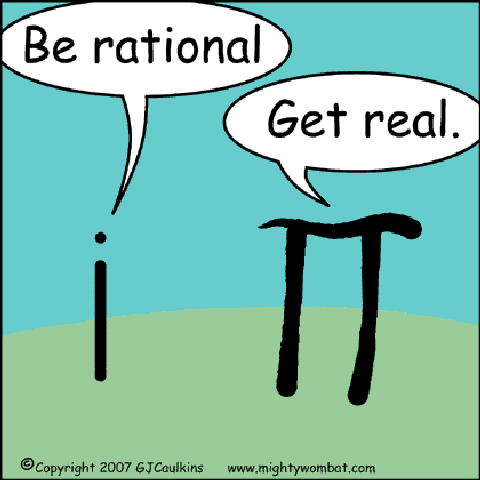
Hopefully that makes some sort of sense. Don't forget, tommorow's pi day!!

Tuesday, March 11, 2008

Tuesday, March 11

We began the class by discussing Accelerated Math. The deadline to master 9 objectives has been moved to the end of class on Friday. Also on Friday, we will be given a pre-test to take home in preparation for the test on Wednesday, March 19. The answer key for the pre-test will be made available on Monday.

Today we started learning about Trigonometric Identities. The following slide shows the definitions of a trigonometric function and a trigonometric identity. We learned that identities are a lot of logic and used a circle, triangle, and square to figure out some of the concepts of identities. We also used Graphmatica to check. It's important to remember that a graph can disprove an identity, but it cannot prove one.


The next two slides show some of the
common identities we will be using. Note that the first slide needs to be memorized, but the identities from the second slide are found on our formula sheet.


This slide shows an example using an identity to solve a problem. One thing to note is the rationalization of the answer. Mr. Max said that he prefers a rationalized answer, but we won't lose marks on the exam if they aren't. Just watch if he puts on the tests to rationalize our answers.


Here is an example of how to simplify an equation using identities.


The assignment from the cumulative exercises for tonight:

So you may have noticed the word nefarious seemingly randomly placed on one of the slides. Here's the dictionary.com definition: extremely wicked or villainous. It was used in reference to a plot that each of us are capable of concocting, but most certainly never would. Hopefully that clarifies for anyone else who didn't understand.


www.blazelabs.com/pics/donkey.gif


Again, I would appreciate questions and or comments about my post that would go towards making it better. Adios.

Friday, February 22, 2008

February 22nd


Well, I didn't make it to school today but through the wonder of the World Wide Web, I can still be the scribe. If anything important math-related happened to occur today, I would ask that one of my classmates would share it, either with a comment or a separate blog post. I found this picture on the Internet and thought it somewhat applicable.


I think Luke summarized yesterday's class fairly well so I don't need to add much to that. The one other thing I was going to mention is that Mr. Maksymchuk has handed out Accelerated Math sheets to us and he also gave us the scantron sheets. I think everyone understands how to use a scantron sheet, but just in case someone doesn't, I'll give a few pointers. Remember to use pencil only! A good idea is to write your name on it first, then fill in if it is a practice, exercise, or test, then fill in the numbers from the top of your question sheet. After that, it's a simple matter of filling in the answers from your sheet.
Something else I would like to point out is that Mr. Maksymchuk added a window (I think that's the proper blogger term to use) into another Grade 12 Precalc blog. I would advise everyone to check it out as it is an excellent blog (as is ours) and I think it has a lot of good stuff on it.
For the questions assigned from Exercises 5 and 6, I had to use the answer key for the first couple of questions because I either didn't know or had forgotten what "general solution" meant. Here's the dictionary.com definition:
general solution
–noun Mathematics.
a solution to a differential equation that contains arbitrary, unevaluated constants
Basically, it means the whole solution, not just the solution over a set interval. Or that is my understanding of it.
If anyone has any questions or suggestions about making my post better, please leave a comment and I'll try to get on it ASAP.
Bethany

Monday, February 11, 2008

My Goals

Hello all. Here are some goals of mine:
  1. My main goal for Pre-calculus 40S (and all my classes really, but especially this one) is that I won't be distracted by my friends and that I'll be able to stay focused on my work.
  2. I've also set a personal goal to achieve honor roll, so it will be very important to keep my math mark above 80%.
  3. Blogging is a fairly new thing for me so I'm looking forward to learning more about it.

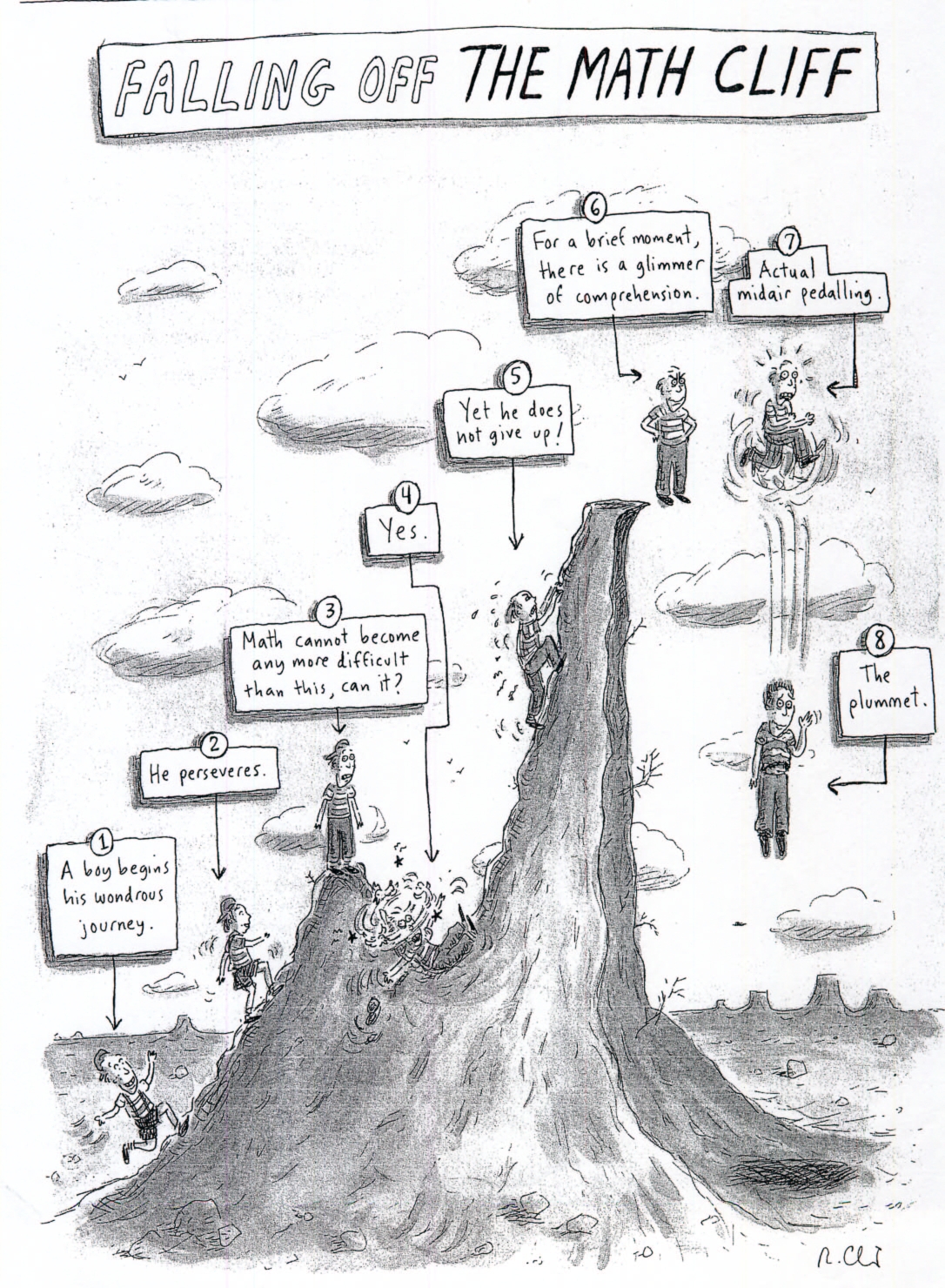
http://math.ucr.edu/home/baez/math_cliff.jpg

Here's hoping no one in our class falls off the math cliff.

I found this site with some sweet math games so I would advise you all to check it out.
http://www.billybear4kids.com/games/mapedit/math1.htm

Here's another great reference site. I found it had clear definitions and a lot of information. It's built with mathematica technology, which is extremely useful if I remember correctly from my grade 10 applied days...

http://mathworld.wolfram.com/

Friday, February 8, 2008

Friday Feb 8th

We started class today with our first mental math. Then Mr. Maksymchuk handed out a package of useful information on circular functions, which is our first unit. The page I found particularly interesting was the page listing some common mistakes students make and then the right answers. There were also learning techniques, like concept maps, word circles, and LAPS sheets. Then we went over questions 6 and 5 from our homework, as the slides beside and below show. For question 5, we first did it by converting from radians to degrees, then converting the answer back to radians, but then we realized it would be less complicated to do the entire question in radians.


The next thing we learned in class was how to post on the blog. We will be taking turns being the scribe. The scribe's responsibility is to post any notes from the day's class, then add relevant information. As far as uploading the day's notes, Mr. Maksymchuk will save the slides as notebook slides (which we don't have the proper software to open), pdf files (which we can view on any computer with Adobe Reader), and as png files. These image files (the png) are the ones that we can uplaod to the blog. We sign in to the blog, then click the new post link in the top right hand corner. There's an option to upload a picture. Browse to my computer, rsfiles, coursework, math, block four grade 12 precalculus, and find the images, which will be labeled by date and information. After we add the images, we add text and publish our amazing blog post.
There was no homework assigned for the weekend. Mr. Maksymchuk is going to be away on Monday, so be prepared to do some reading and more questions in the exercises.